

Two Points from Critical
One small step for the “man” — one giant leap backward for mankind.

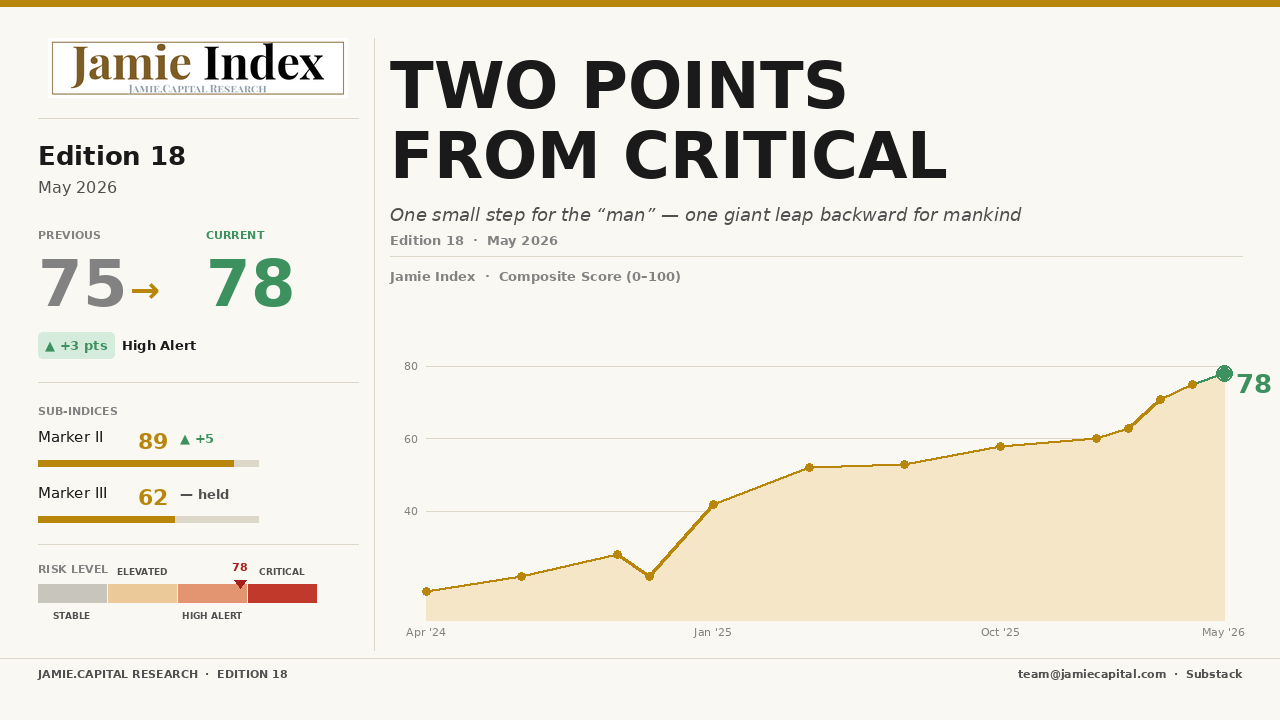
The Jamie Index is designed to measure and benchmark against historical markers that show the path to civil war and global war. Once the index passes 80 points on a scale of zero to 100, it sits in territory where historically resolution has not been possible and war has followed.
I am a specialist in measuring bad situations. Typically I use the technology I have learned to measure conditions of poverty around the world. Historical events are usually well documented when war is involved, and so it is now possible — using social-index methodology and AI — to go back and measure the preconditions of war. That is what I am doing here.
The Jamie Index is 60% weighted to the fracturing of the USA and 40% to Russian aggression, calibrated to the Cuban Missile Crisis.
The fracturing of various elements of constitutional stability in the US is being carefully measured, and I am afraid the situation is pretty bleak at the moment. The pace of the breaking of norms continues at a rate that suggests a very difficult future, unless there is a strong change in political will.
King Charles III, in his address to the US Congress, took us on a historical tour from 1215 to today — about the need, necessity, and brilliance of building constitutional restraint over people like himself, a monarch. It was, in a way, a fabulously ironic speech, given that it was delivered by a monarch — but one who clearly revels in his constitutionally limited role.
We are two points away from 80.
I have recently published The Rupture Sandwich, a book laying out how the Jamie Index and its sister instrument, the Civil War Net Score, were built; where the trajectory they are currently on is pointing; and how to change course. I have been amazed by the number of people who have told me they really do not want to read the book because they cannot bear to think about what it might mean. Let me make this clear: if you read the book and face the reality, you can change it. If you don’t, you can’t — and it is more likely to devour us all.
Let me go into the details of this month’s update.
What moved this month
On the second of May, the Washington Post and the Associated Press published a joint investigation that documented thirty-one district-court orders violated in the first fifteen months of the administration. Judge Sunshine Sykes of the District Court for the District of Columbia, writing in February, said that administration officials “seek to erode any semblance of separation of powers” and could “only do so in a world where the Constitution does not exist.” The pattern is straightforward: the executive routinely ignores district-court orders without ever taking the case to the Supreme Court, where the order would either be enforced or struck down. Because the case is never appealed, the higher-court check never gets a chance to operate. The orders sit unenforced. The constitutional system loses its terminal constraint by simple non-engagement. Lawfare, the specialist legal journal, describes this as defiance below the Supreme Court level. It is not a sequence of isolated incidents. It is the working operating system of the executive branch.
Three days later, the Defense Secretary defended the firing of the Army Chief of Staff in a House hearing where Republican concern was visible for the first time. The next morning, reporting from across the Pentagon press corps converged on a single phrase to describe the institutional mood: You wonder if you are next. That phrase reached the Navy Secretary’s office, the Hegseth–Driscoll feud at the highest civilian leadership level, and the cross-service uniformed corps. What had been an Army-specific chilling effect in April became, in May, the saturated condition of the United States military.
These two developments — the pattern of unenforced court orders and the Pentagon ceiling — are what moved the Jamie Index this edition. Both Chilling Effect indicators reached the methodology’s ceiling of 5/5. Two of the three Legal & Constitutional Friction indicators (Executive–Judicial Conflict and Constitutional Crisis Indicators) reached 5/5; the third (Congressional Alarm) held at 4/5. Marker II — US Institutional Fracture — moved from 84 to 89. The Jamie Index Composite moved from 75 to 78. Russian Opportunism (Marker III) held flat at 62. The driver remains internal.
What the cap is doing
The companion instrument, the Civil War Net Score, gives a different surface reading. The published CWNS stays at 6/7 this edition, unchanged from April. Under the hood, the picture is not the same. Two CWNS variables — Legislative Gridlock and Institutional Capture — reached ceiling in May. The unbound pressure value, Raw, moved from 36 to 38. The methodology contains a cap rule: when Military Violence is below 5, the published Final cannot exceed 6 regardless of the other variables. Military Violence holds at 3 this edition. The cap continues to bind.
The gap between the unbound pressure (Pre-Round 10) and the cap-bound Final (6) is now four points. That is the widest binding gap in the CWNS calibration record, which extends back to the 1642 English Civil War anchor. The published Final increasingly understates the under-the-hood pressure. From Edition 18 forward, the live dashboard displays Final and Raw side by side. The 400-year historical chart continues to display Final only, for continuity.
This is the consequence: Military Violence is now the single decisive variable for an outbreak signal. With five of the six pressure variables at or near ceiling, any move in Military Violence to 5 or above lifts the cap, and the published score steps from 6 to 7 in a single edition.
The score block
For readers who want the numbers without the prose around them:
Jamie Index           78          HIGH band  ·  2 pts to Critical (80)
Marker II             89          US Institutional Fracture  ·  +5 vs Ed-17
Marker III            62          Russian Opportunism  ·  held
P(Crisis)             50%
Direction             ↑           Trending higher

CWNS Final           6/7          Cap-bound (MV < 5 → max 6, ADR 0002)
CWNS Raw              38          Pre-Round 10  ·  gap to cap = 4 (widest in record)
CWNS LG               7/7         Legislative Gridlock — ceiling reached this edition
CWNS IC               7/7         Institutional Capture — ceiling reached this edition
CWNS MV               3/7         Military Violence — held; single decisive variable
CWNS CE               0           Common Enemy — held (Iran war won-but-divisive)

Coverage window       15 April – 11 May 2026  (27 days, short)
CMC calibration       Jamie Index 78 = 2.4× the Cuban Missile Crisis equivalent
The arithmetic is auditable. Jamie Index = round(0.6 × 89 + 0.4 × 62) = round(78.20) = 78. P(Crisis) = 89 × 62 ÷ 11100 = 49.71% → 50%. Sources, evidence rows, and the per-indicator rubric for both instruments are in the canonical change logs (see footer).
Russian Opportunism stays at five out of five
Marker III holds at 62. No individual indicator moved this edition. The Russian Reading of US Disarray indicator — the Opportunism Window — stays at 5/5, which remains the highest reading in the twenty-six-month backtest. President Putin’s tenth-of-May statement that the war is “coming to an end” and that he is willing to meet President Zelenskyy reads as Russia perceiving leverage, not as a strategic shift. The three-day Victory Day ceasefire of the eighth to the eleventh broke down by the third day with mutual breach accusations. The Trump-brokered diplomatic re-engagement complicates the surface but does not change the structural picture.
In October 1962, during the Cuban Missile Crisis, the Opportunism Window was near zero. Kennedy had complete institutional unity. Khrushchev saw no opening. Today, the Marker II reading is 89, the Pentagon chilling effect is saturated cross-service, district-court orders are being defied without ever reaching the Supreme Court, and the Opportunism Window stays at maximum. The historical asymmetry is the entire signal. Moscow does not need to act. It needs to watch.
